Planning moves in number puzzles that change their neighbours
Read the neighbours before you act. In 2048 Lines and in Zero Out Puzzle, one input reaches further than the thing you aim at, so the habit worth building is a short look at what sits next to your target before every move.
Why a quick move often goes wrong
Most mistakes in these puzzles come from looking at a single square and ignoring the rest. You spot an obvious place for a cube, or an obvious block to press, and you go for it. Then the board answers in a way you did not plan.
Both games ask for the same care from different directions. One has a descending field that keeps moving while you think. The other lets you take as long as you like, but it punishes a careless order of moves just as firmly.
How 2048 Lines asks you to read the board
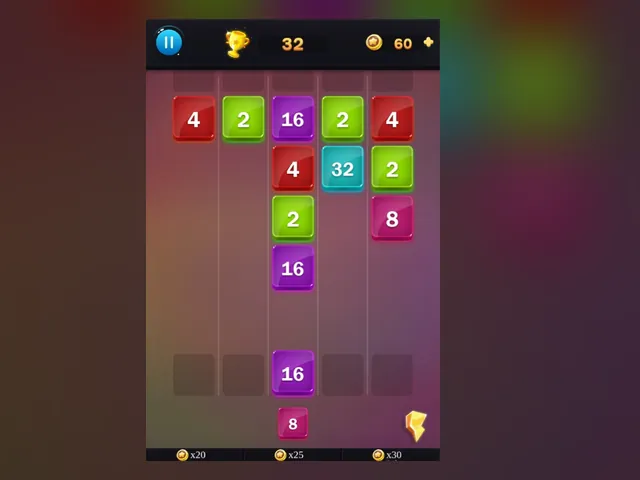
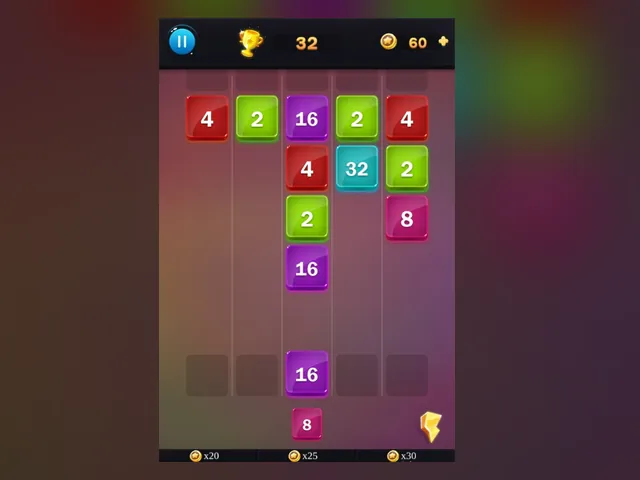
Play happens on a 5x5 grid. A numbered cube is the piece you control, and you send it toward the descending field at the top. When it meets a neighbouring cube on its left, right, above or below, their values add together, so two cubes of 2 become a 4.
Each turn follows a loop. You send a cube, merge what you can and look at the wall again. A round is over the moment a cube from the descending wall touches the bottom, which is why the reading you do between sends matters more than the sending itself.
Find the equal pairs first
Two equal cubes join into the next number up, so scan for matching values before anything else. A pair that already touches is a merge waiting for you. A pair that sits one column apart is a plan, because your next cube might be the one that links them.
Watch the wall more than your cube
Staring at the cube in your hand is tempting. The cube is not the danger. The wall is, and it keeps coming down whether or not you have decided yet.
Look at how close the lowest cube of the wall sits to the bottom, then pick the spot that does the most useful work there. A merge that clears space near the bottom is worth more than a tidy merge near the top.
Keep the small values together
Small values merge in chains when they are neighbours. A 2 beside a 2 becomes a 4, and if a 4 already sits beside that, the chain carries on. Scattered small numbers cannot do this, so think about where the next cube lands in relation to the ones already there.
A pause button sits at the top of the screen. Use it when you want a little time to study the layout. Pausing to think costs nothing, and a wrong send can cost a lot.
How Zero Out Puzzle asks you to read the board
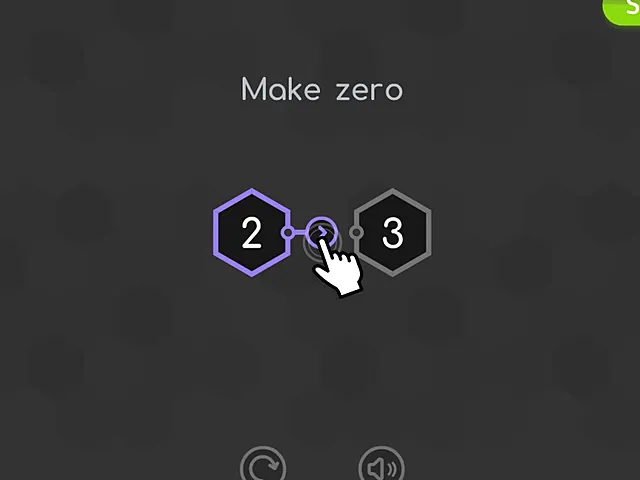
Here the goal is to turn every numbered block to zero. The thing you press is the small arrow between two hexagons. Each press changes the numbers on the blocks it links, and the blocks next to the one you act on shift as well.
That last part is the whole puzzle. The neighbours are part of the sum, so a press that fixes one block can disturb two others. Working out the full effect before you press is what separates a clean board from a tangled one.
Choose where to begin
Start with the block that has the fewest neighbours. A move there disturbs less of the board, so you learn what a press does without undoing earlier work. Once the quiet corners are settled, the busier blocks in the middle are easier to judge.
Deal with the high numbers early
Your highest numbers need the most presses to bring down, so keep an eye on them from the start. Leaving them to the end means you may run out of useful presses at the moment you need them most. Later boards are more intricate, which makes this ordering matter more as you go.
Try another order when two blocks are stuck
Sometimes two blocks end up on awkward numbers and nothing seems to help. Try a different order of moves and see how the same board behaves. A Skip Level button is on the screen too.
A routine that works in both
Different as they look, the thinking underneath is shared. Before each move, run through the same short checklist.
- Name the target: the cube you will send, or the arrow you will press.
- List what touches it: the cubes beside a landing spot, or the blocks beside the linked pair.
- Work out the result for each of those neighbours, not only for the target.
- Look one move further ahead on bigger or busier boards.
- Only then press or send.
Slow as that sounds, in Zero Out Puzzle it is allowed to be slow. In 2048 Lines the same routine has to run quickly, which is a skill in itself. A pause is there for the moments when it does not.
How the two compare
| Aspect | 2048 Lines | Zero Out Puzzle |
|---|---|---|
| Goal | Join cubes, reach a high score | Turn every block to zero |
| Input | Send a cube toward the wall | Press an arrow |
| Pace | The wall keeps moving | You decide when to press |
| Helper button | Pause button | Skip Level button |
| Round ends when | The wall touches the bottom | All blocks reach zero |
The difference that matters is pace. One game wants decisions at a steady rhythm, and the other wants decisions to be right.
Which one to open first
Anyone who likes arithmetic with a hint of speed and enjoys chasing a higher score can start with 2048 Lines. It works well for a short break, and longer sessions work too if you want to push your best round further. Do not expect much time for slow thought, because the wall does not wait.
If you would rather work a small sum through in your head and then test it with one press, open Zero Out Puzzle. The board is plain, with only numbers in hexagons and no scenery to lean on, so it suits you best if you came for the puzzle and nothing else. Trying a different order of moves keeps a wrong guess cheap.
For a practical order, try Zero Out Puzzle first. It teaches you to check every neighbour with no pressure on you. Then carry that habit into 2048 Lines, where you will have to do the same check a little faster.