Sudoku Village
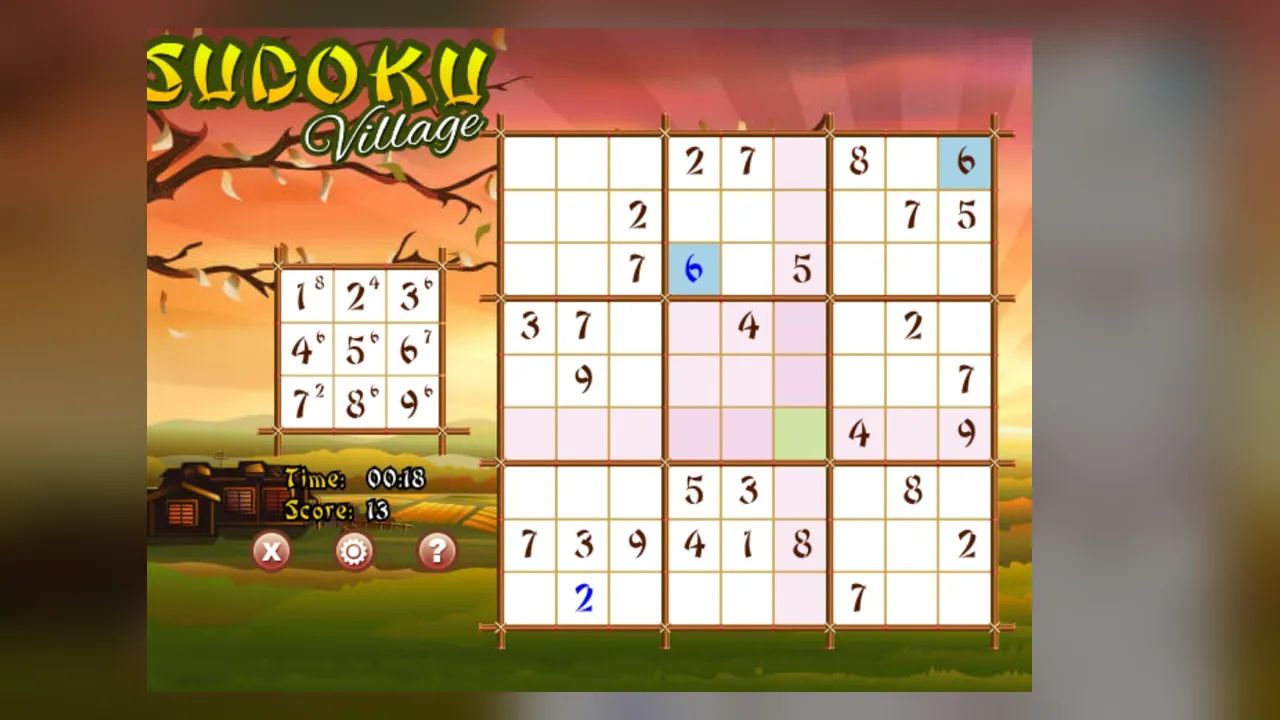
Numbers one to nine wait in a small panel at the left. Empty squares wait in the grid on the right. Your entries show up in blue.
The Time and Score readouts sit under the number panel at the left, beside the grid. The screen is simple, and the grid is the main thing to look at.
The puzzle itself is classic sudoku. Some squares start filled in, and you supply the rest. When you highlight a square, its row, column and 3x3 box pick up shading, which helps you check each number before you commit to it. The 3x3 squares are easy to pick out on the grid. Every placement is a small decision, and the grid rewards the ones made with care.
How to play
When a puzzle opens, some squares are already filled in. Fill every empty square with a number from 1 to 9 until the grid is complete. Pick a square, check its row, column and box, then place the number that fits. Your own entries appear in blue, so you can tell them apart from the starting numbers. Keep going until no empty square is left, and make sure none of the three groups repeats a number.
- Each row holds the numbers 1 to 9 once.
- Each column holds the numbers 1 to 9 once.
- Each 3x3 box holds the numbers 1 to 9 once.
- The numbers already on the grid are your clues.
Controls
| Input | Action |
|---|---|
| Number panel, 1 to 9 | The digits you can place in an empty square |
| Grid squares | Empty squares take your entry, shown in blue |
| Round buttons under the readout | Marked x, a gear and a question mark |
Tips
- Scan the 3x3 boxes that already hold the most numbers, because fewer gaps mean fewer possible entries.
- Start with a digit that appears many times on the board, then look for the boxes where it is still missing.
- Use the shading on the highlighted square's row, column and box to see which numbers are already taken.
- Check every entry against its row, column and box before moving on.
- Keep a steady rhythm. The Time and Score readouts run beside the grid, but a correct grid matters more than a fast one.
- Take a fresh look at the whole grid after each placement, since one new number often unlocks a square somewhere else.
Screenshots
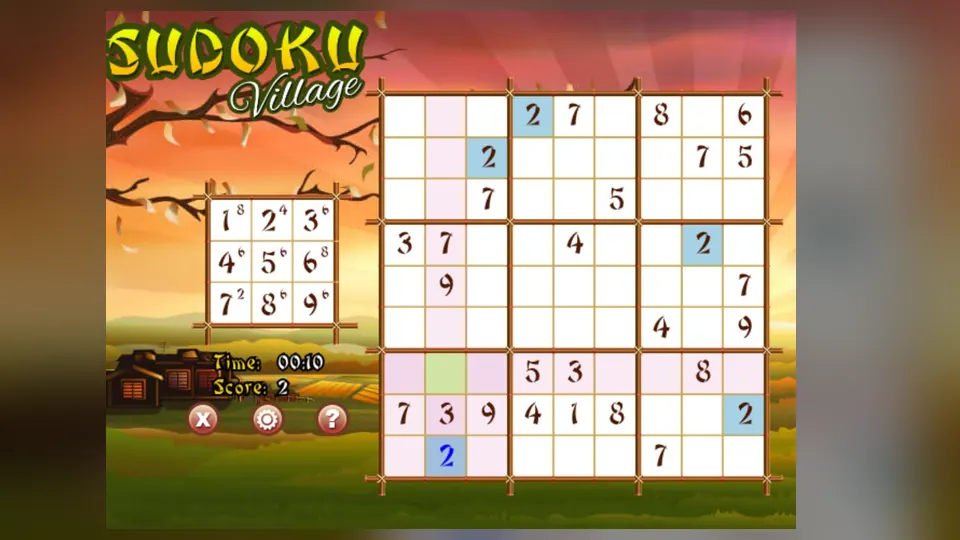
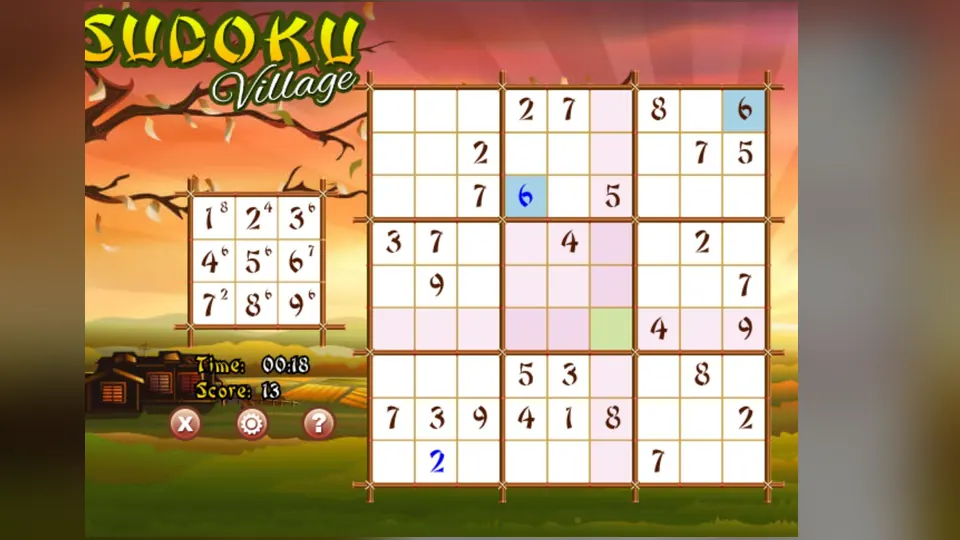
Our take
The best moment arrives when a stubborn box finally gives way: you place one number and the squares around it fall into line. That payoff comes from a clean, readable 9x9 grid with helpful shading, rather than from extras. Newcomers can learn the three rules by watching the shading follow a square, and experienced solvers get a familiar test on a tidy board. The trade-off is that it sticks to the classic format, so anyone after twists on the rules will find the usual sudoku instead.
Common questions
What are the most common beginner mistakes?
Repeating a number that already sits in the same row, column or 3x3 box. The box is the one people forget, so check all three before placing a number.
How can I see which numbers are already taken?
Highlighting a square shades its row, column and box. Any number you can see inside that shading is ruled out for that square.
Is there a clock or a score on screen?
Yes. A Time readout and a Score readout sit at the left of the grid, below the number panel.